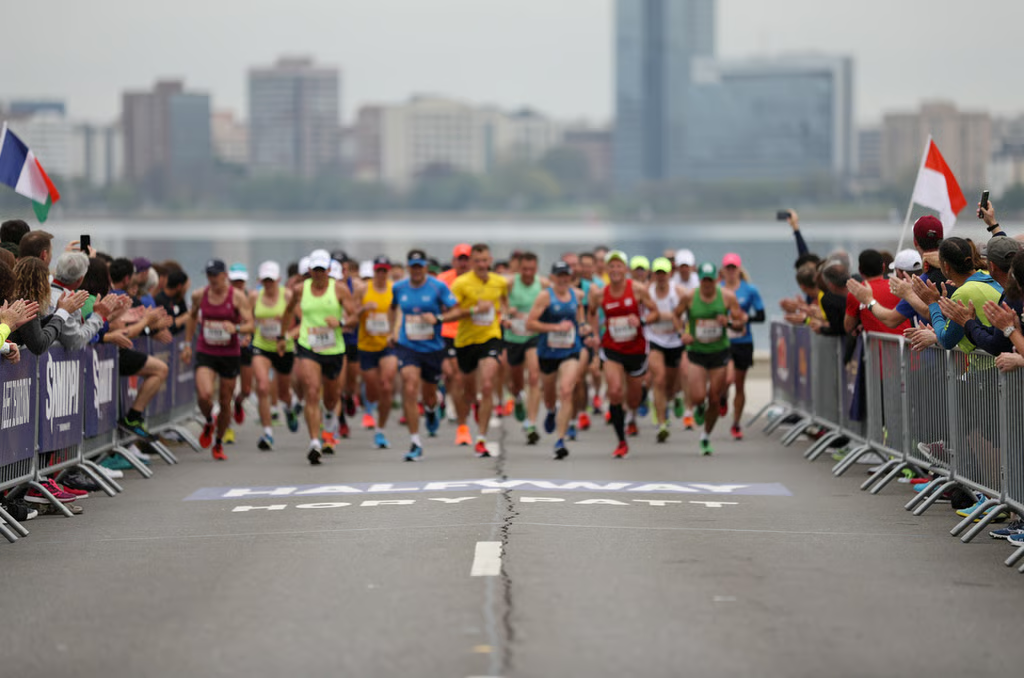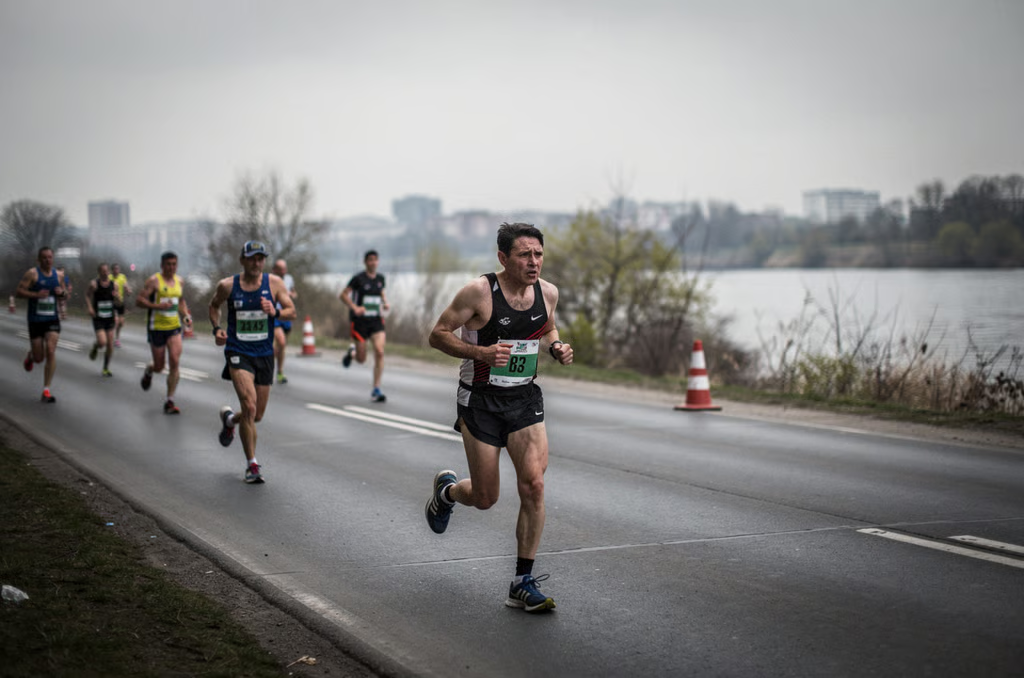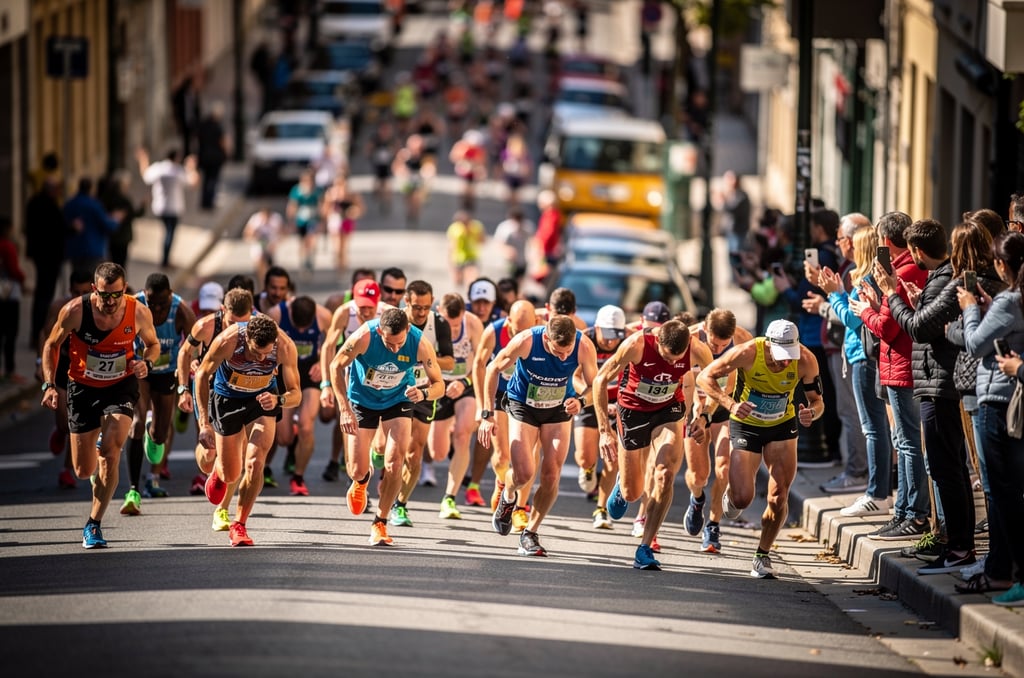
Marathon runners packed into the start corral at dawn

The Last 10K

Fifty thousand people will run 26.2 miles through New York this morning. Most of them will decide how their race goes somewhere after mile 20.

By [Writer name] · Photographs by [Photographer name]

he pace group pulled away from Maya Ortiz at the 20-mile marker, and for the first time in more than three hours she could not make her legs answer.

She had trained for this for 16 weeks. She knew the numbers: the pace on her watch, the gels in her belt, the 10:18 a mile she needed to finish under four and a half hours. None of it explained why the next step felt twice as heavy as the last one, or why the crowd at the barriers suddenly sounded very far away.

Her coach had warned her about this stretch. Somewhere after 18, he told her over coffee in September, you stop feeling like a runner and start feeling like a passenger. She had laughed at the time. Nobody around her was laughing now.

The field had thinned into a loose line of strangers, each running a private negotiation with their own legs. A man in an orange singlet stopped to stretch a calf against a lamppost. Two friends in matching shirts had stopped talking a mile back. The only sounds were shoes on asphalt and a drum line somewhere near the bridge.
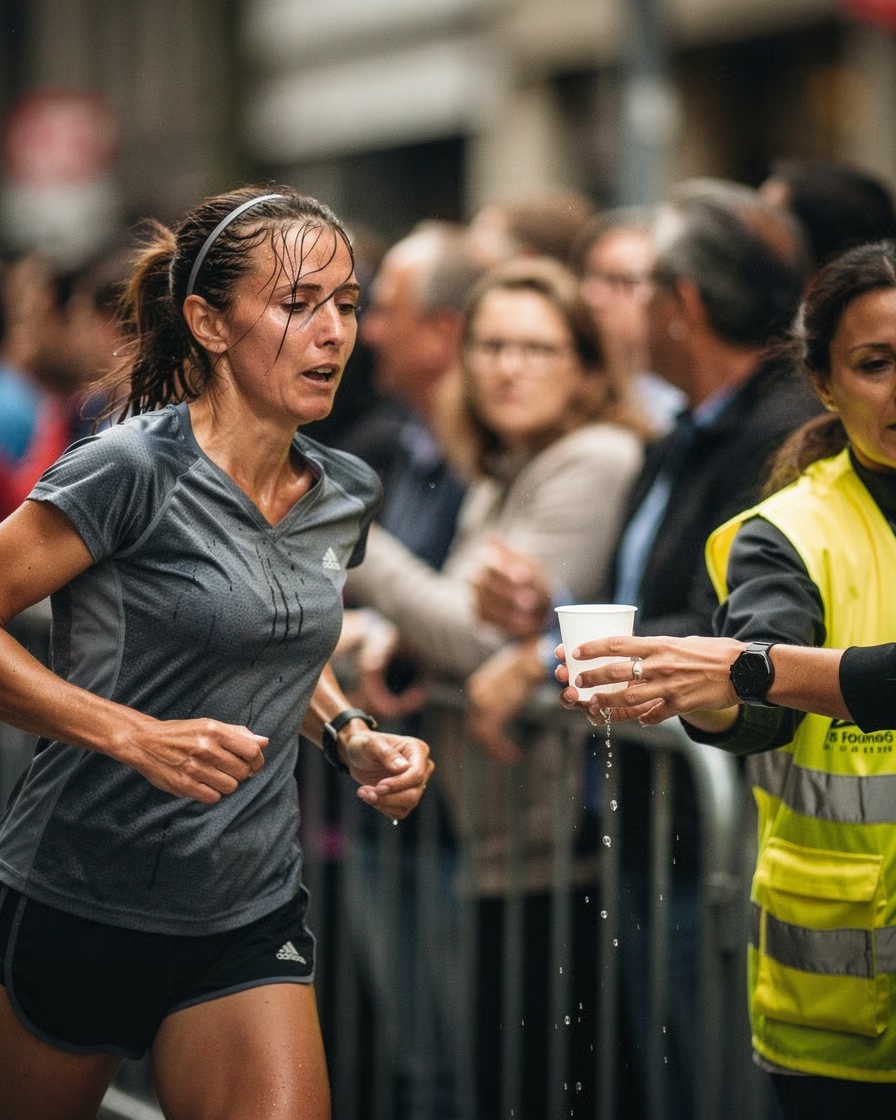
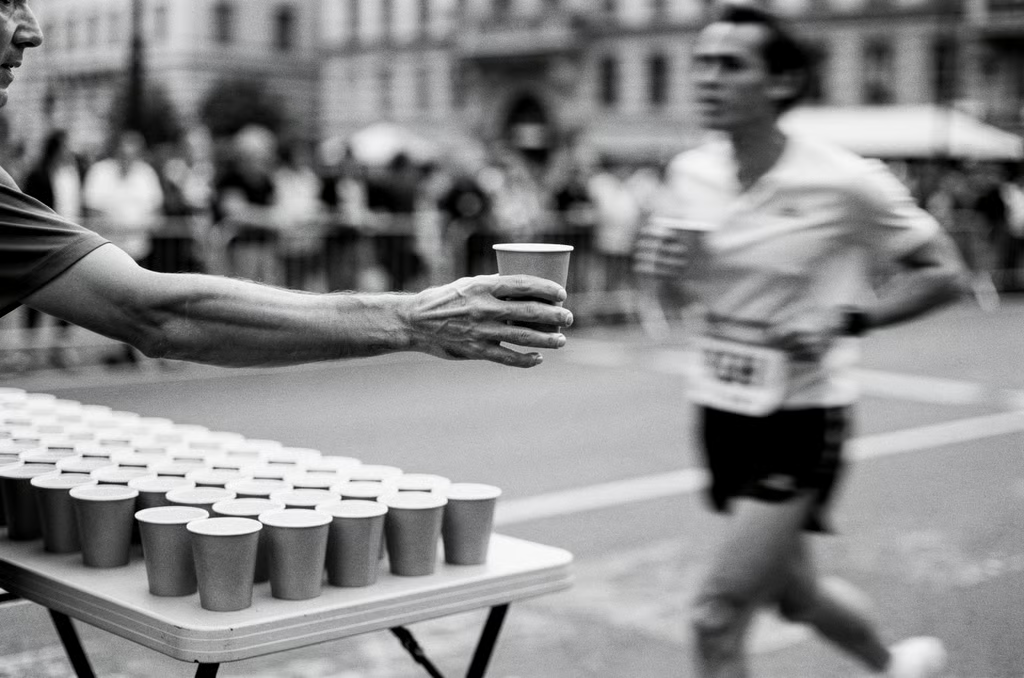
Runner taking water from a volunteer

A volunteer hands out water at the mile 20 aid station, where many first-time runners walk for the first time. [Photo credit]

At mile 20 the course leaves the river and starts a long, shallow climb toward the park. It is not steep. On fresh legs most runners would barely notice it. After 32 kilometres, it looks like a hill someone moved into the road overnight.

She slowed to a walk for the first time since the start line. A volunteer in a yellow vest held out a paper cup. She took it, spilled half of it down her shirt, and started running again before she had decided to.
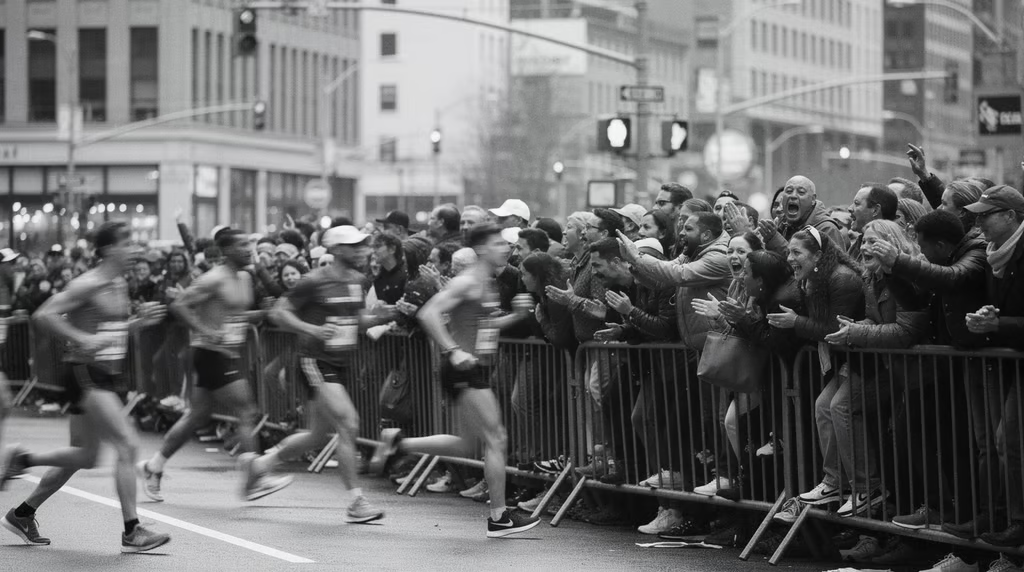
Spectators cheering behind barriers on the marathon course

Spectators lean over the barriers near mile 21, where the course turns back toward the city. [Photo credit]

Runners have a name for this. They call it the wall, and nearly every first-timer on the course this morning will meet some version of it in the next six miles.

This is the story of those last six miles: how runners train for them, how the course is built around them, what the body burns to get through them and why a million strangers line the streets to watch.

The wall is not a myth, and it is not only in the head. Around the 20-mile mark many runners burn through the glycogen stored in their muscles and liver, and the body leans harder on fat, a slower fuel. The pace that felt easy at mile 10 suddenly costs far more effort.

What happens next depends on the months of preparation behind each runner, the shape of the road ahead and, more than most people expect, the voices at the barriers. For Maya, the next 10 kilometres would test all three.

The Course ▸

Before the gun

50,000

runners, leaving in four waves from Fort Wadsworth on Staten Island

7:22

a.m., when Maya’s wave crosses the start line

10:18

the pace per mile she needs to finish in 4:30

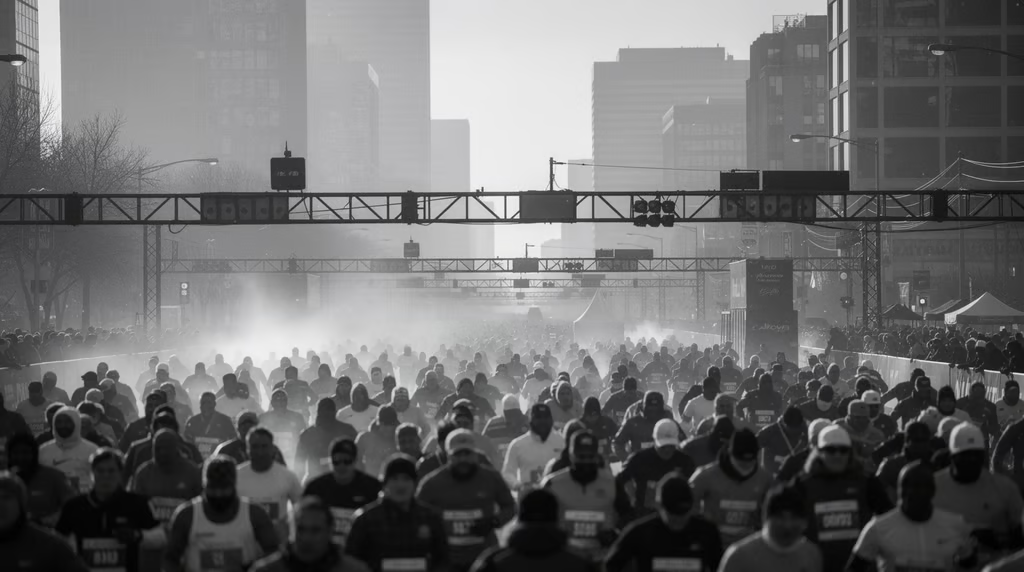
At six in the morning the corrals at Fort Wadsworth are already filling. Fifty thousand runners pin on bibs, retie their shoes and run the math one more time. Few of them are worried about the first 20 miles. The race they are thinking about is the last 10K.

The Course

Every marathon is 26.2 miles, but no two courses run the same. New York starts on a bridge, crosses five boroughs and saves its longest climb, up Fifth Avenue, for mile 23. Maya Ortiz will run every one of those miles this morning.

The elite runners at the front will cover the first half in about an hour and the second half in nearly the same time. That even split is the hardest thing in the sport to learn, and the thing most first-timers get wrong.

Mile 2 · 7:42 a.m.

Maya comes off the Verrazzano right on 10:18 a mile, though the downhill keeps asking her to go faster.

Elevation along the course

Height above river level, in feet. The steepest climb on the course comes three miles after the wall.

Hover or tap a marker on the profile to see the course at that spot.

Start

Finish, 26.2 miles

Mile 2: onto the bridge, up 60 feet

Dashed lines: halfway and mile 20

Mile 23: up 80 feet in half a mile

Illustrative profile. Replace it with the elevation chart from your race’s official course guide.

Switch between the two runners below to see how much of each race is spent in the last 10K.

Minutes spent on each stretch of the course

From the start line on the left to the finish on the right

29

34

33

14

15

57

68

70

40

45

Miles 0–6

6–13.1

13.1–20

20–23

23–26.2

Illustrative splits for a 2:05 elite and a 4:40 first-time finisher. Replace with official split data from your race.

The elite runner slows by barely a minute over the last 10K. The first-timer loses nearly 20, most of it on the climb at mile 23, where the course rises about 80 feet in half a mile.

The last 6.2 miles take up 23 percent of the elite race and 30 percent of the first-timer’s.

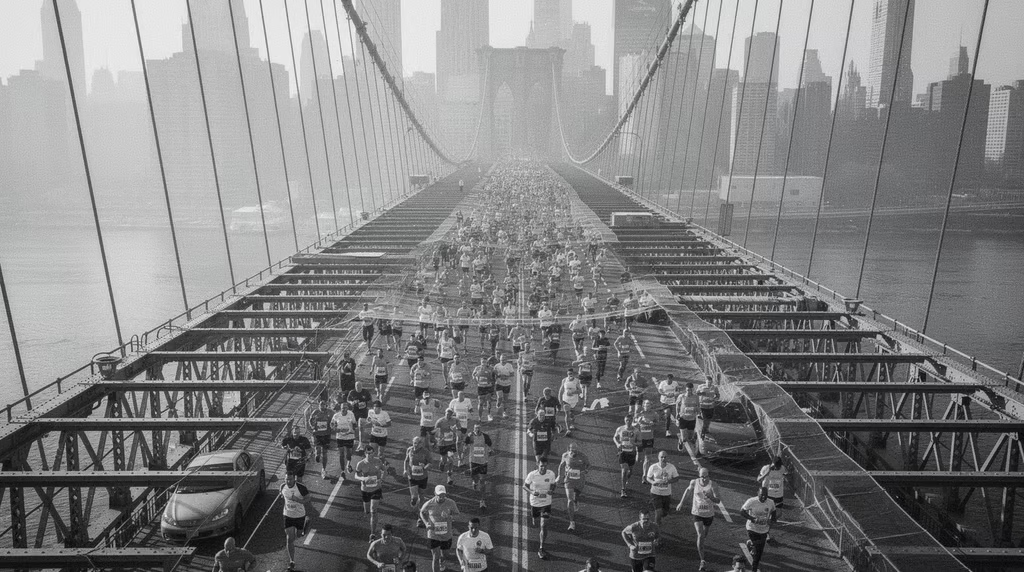
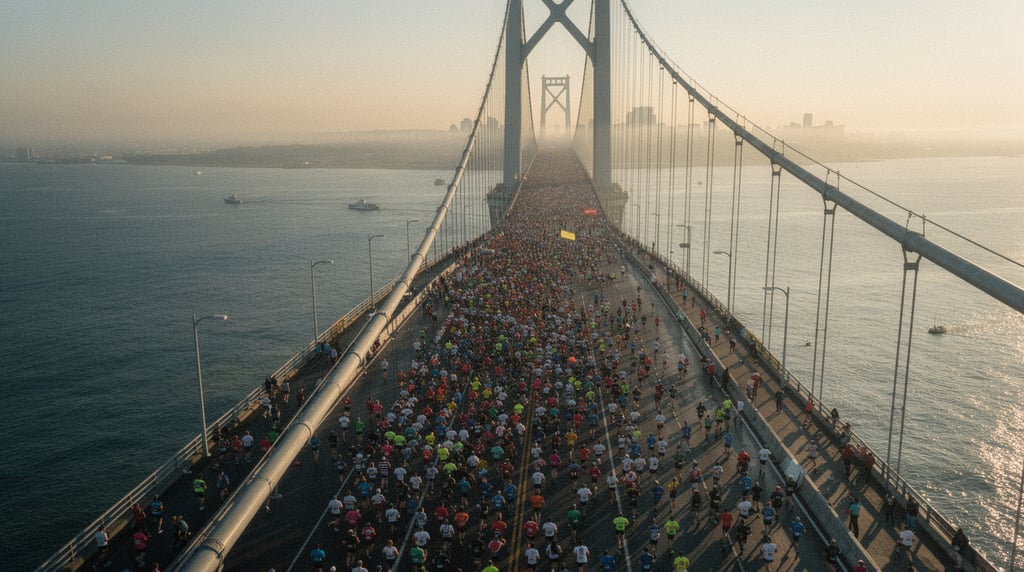
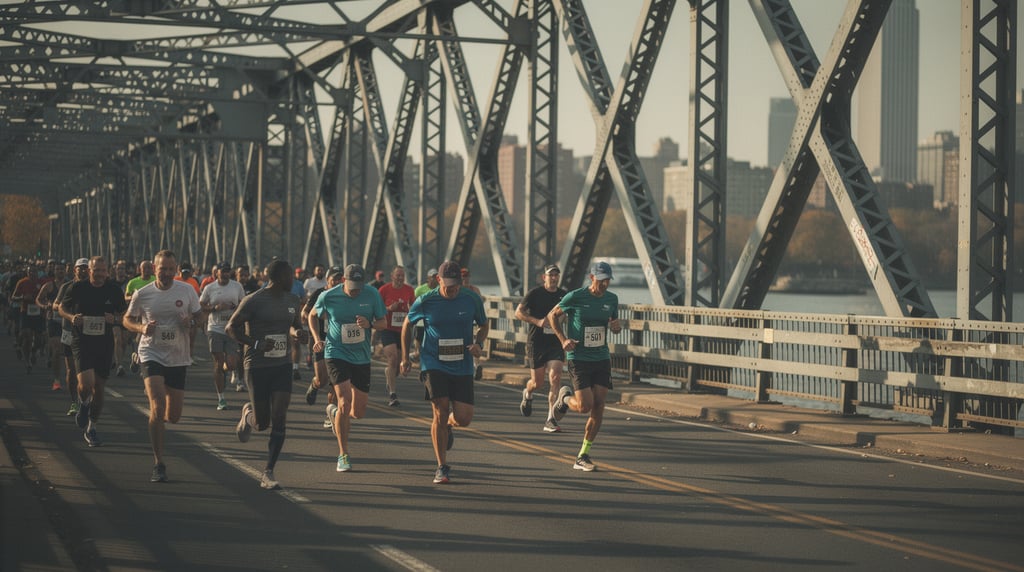
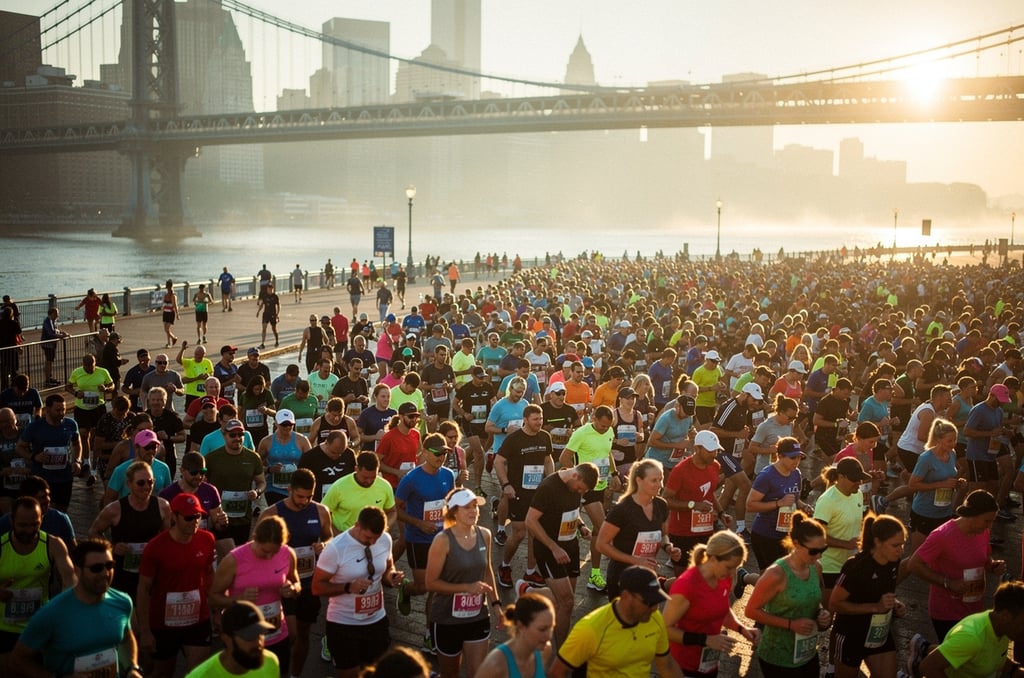
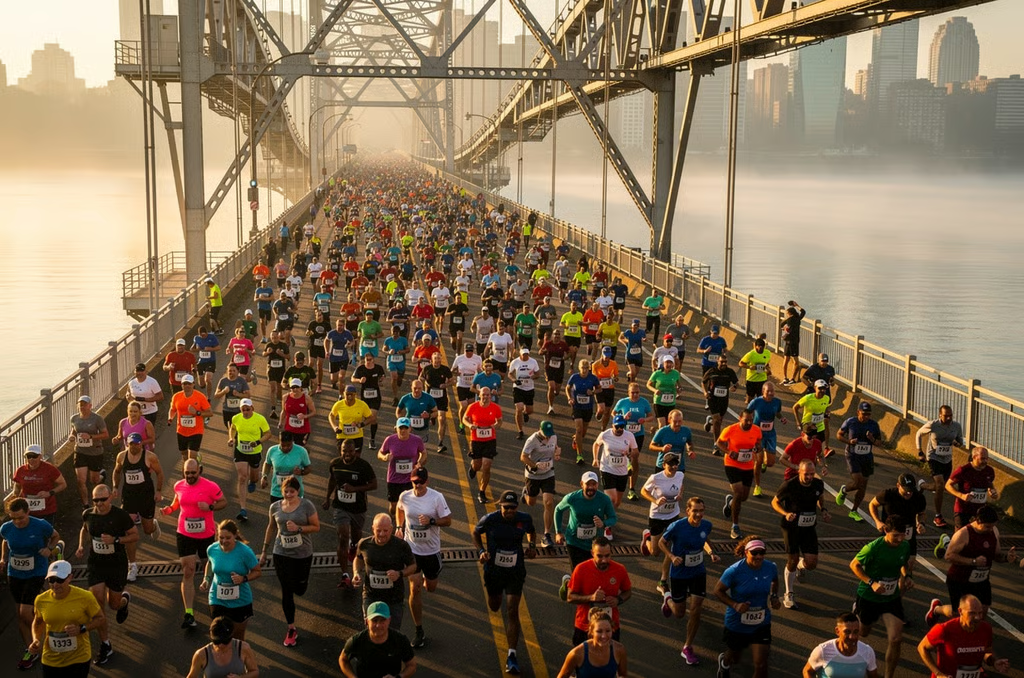
Marathon runners crossing a city suspension bridge

Runners cross the bridge at mile 2, the only point on the course where the whole field can be seen at once. [Photo credit]

Training ▸

26.2 miles through New York

Scroll to fly the route from the Staten Island start to the Central Park finish. Six places along the way decide how the day goes.

NEW JERSEYTHE BRONXQUEENSBROOKLYNSTATEN ISLANDMANHATTANLOWER BAYSTARTMI 1MI 13.1MI 17MI 20FINISH
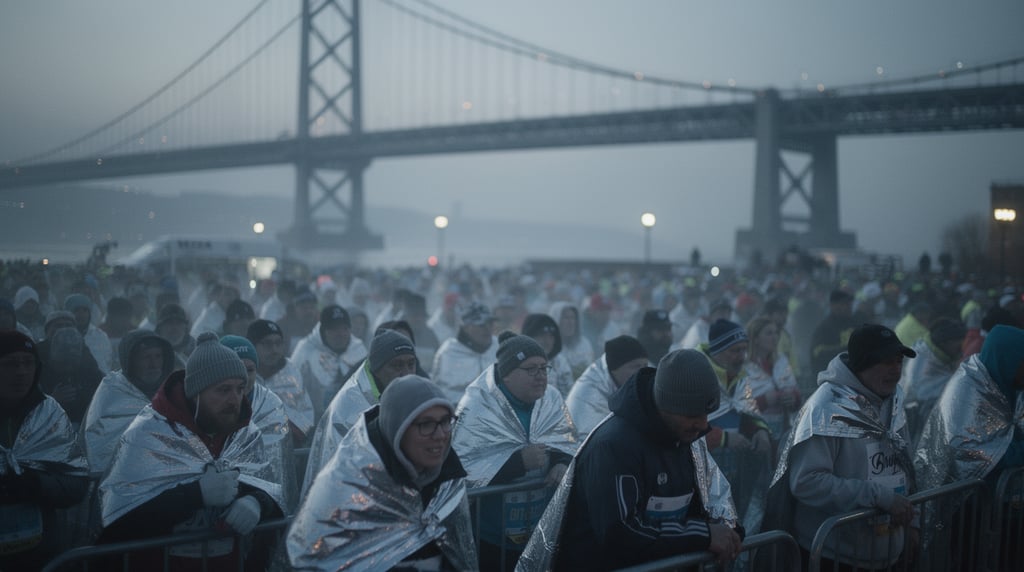
Runners waiting in start corrals at dawn
Runners crossing the Verrazzano Bridge at sunrise
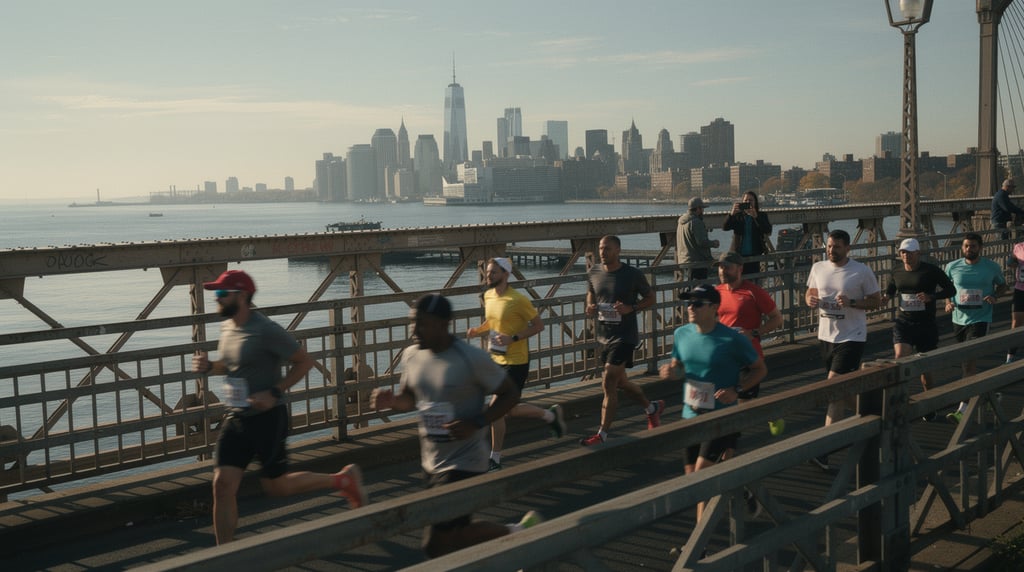
Runners crossing the Pulaski Bridge at halfway
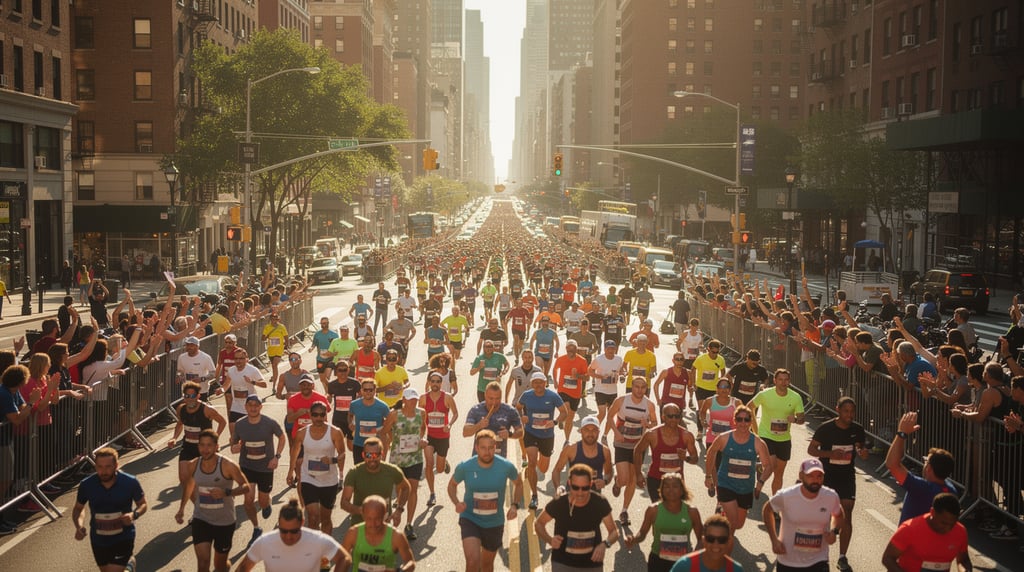
Crowds lining First Avenue during the race
Tired runners crossing a bridge into the Bronx
Final stretch through Central Park in golden light

The start corrals at Fort Wadsworth

Runners arrive hours early and wait in the cold at the foot of the bridge. The layers they shed before the start are collected and donated.

The highest point comes first

The climb to the middle of the bridge is the highest ground of the day. It arrives in the first mile, when legs feel fresh and a too-fast pace feels easy.

Halfway, between two boroughs

The halfway mark sits on a short drawbridge over Newtown Creek. Brooklyn ends here and Queens begins, with the Manhattan skyline across the river.

A quiet climb, then a wall of noise

Spectators are kept off the Queensboro Bridge, so the only sound is footsteps. Then the ramp drops onto First Avenue and into some of the biggest crowds on the course.

Into the Bronx, where races come apart

The course spends about a mile in the Bronx. For many runners this is where fuel runs low and a planned pace starts to slip.

The last turn to the line

After a long, gradual climb up Fifth Avenue, the course enters the park, rolls along its southern edge and finishes near Tavern on the Green.

Fort Wadsworth, Staten Island

Staten Island → Brooklyn

Brooklyn → Queens

Queens → Manhattan

Manhattan → The Bronx

Central Park, Manhattan

Somewhere around mile 20, it gets hard.

Seventy-five years of chasing two hours

Maya is aiming for 4:30, or 10:18 a mile. The current men’s record works out to about 4:36 a mile, less than half her pace, and the fastest marathoners keep closing in on a line nobody has crossed in a race. Since 1947, the men’s world record has fallen by 25 minutes. Since 1971, the women’s has fallen by more than 36. Each column shows how far a record stood above two hours. Switch between the men’s and women’s records, and hover over or tap a column to see the time.

Marathon world record, minutes above two hours

2:25:39

2:20:42

2:18:40

2:17:39

2:15:17

2:14:28

2:12:11

2:09:36

2:08:33

2:08:18

2:07:12

2:06:50

2:06:05

2:05:42

2:04:55

2:03:59

2:03:38

2:02:57

2:01:39

2:00:35

’47

’52

’53

’54

’58

’63

’64

’67

’69

’81

’85

’88

’98

’99

’03

’08

’11

’14

’18

’23

Next

A selection of record-setting runs. The orange column marks the current record: 2:00:35 for men, set in Chicago in 2023, and 2:09:56 for women, set in Chicago in 2024. Both charts use the same scale. Compiled from memory of World Athletics records, which treat women-only and mixed races separately: verify each time and year before publishing.

The record has dropped in jumps: faster shoes, better pacing, deeper fields. In 2019, Eliud Kipchoge ran 1:59:40 in a specially staged event with rotating pacers, but it did not count as a record. The open question is whether anyone can do it in a real race.

Five runs that moved the line

The chart above shows every record. These are the runs that changed what people thought a human could do. Scroll through them and watch the gap to two hours close.

2:25:39

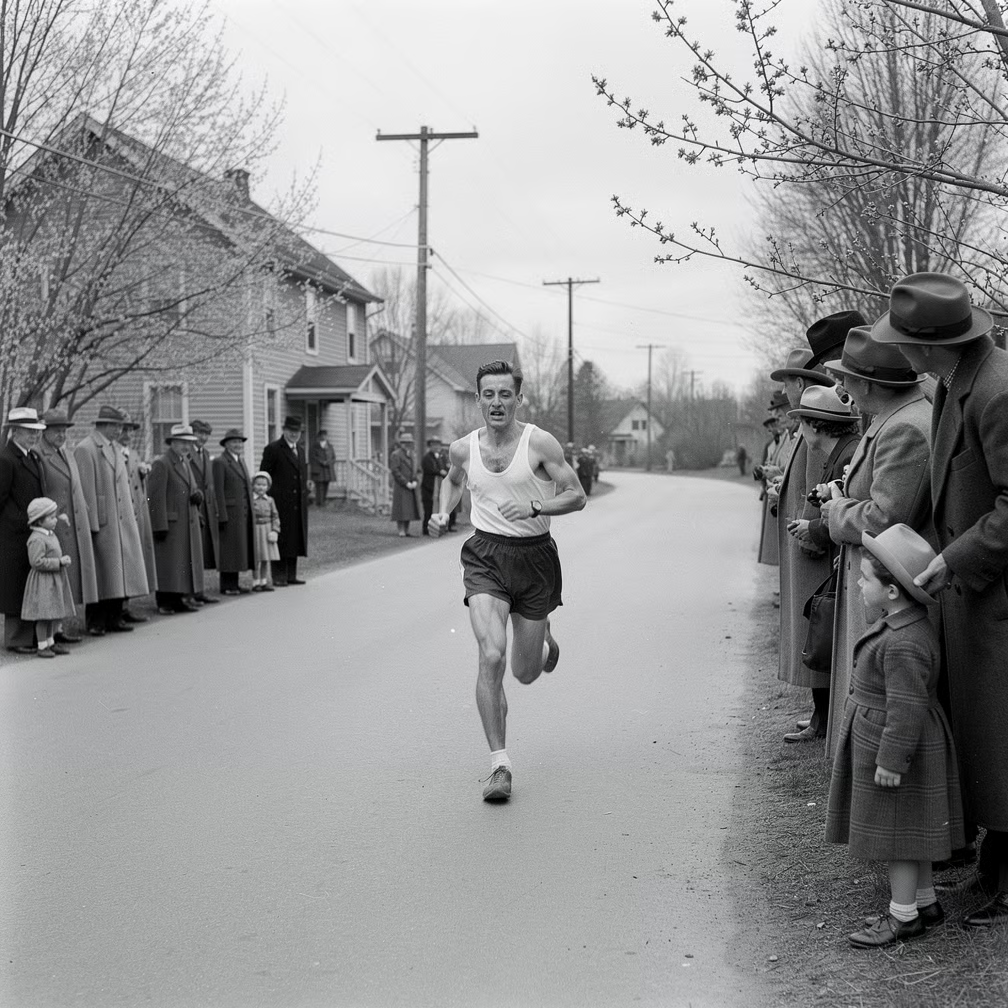
Suh Yun-bok wins Boston

A 24-year-old from Korea wins Boston in a world best that stands for five years. The two-hour line sits more than 25 minutes away.

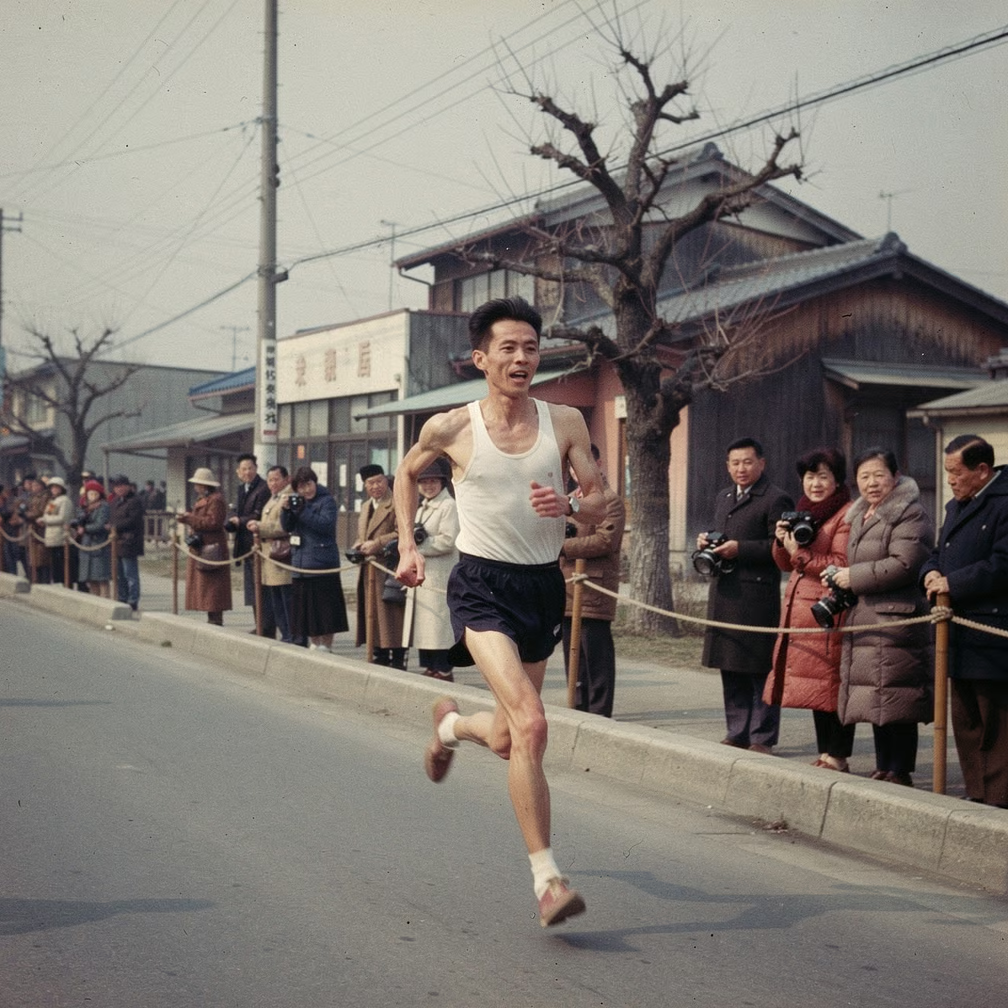
2:09:36

Derek Clayton breaks 2:10

The Australian becomes the first person to run a marathon under 2:10. His training weeks reached about 160 miles, a load that shaped how a generation prepared.

2:04:55

Paul Tergat takes Berlin

Berlin’s flat, sheltered course takes over the record book. Tergat’s run starts a streak of eight straight men’s records set on its streets.

2:01:39

Eliud Kipchoge cuts 78 seconds

The biggest single drop since 1967. It arrives in the era of carbon-plated shoes, which changed how fast the best runners could hold pace late in a race.

2:00:35

Kelvin Kiptum, 35 seconds away

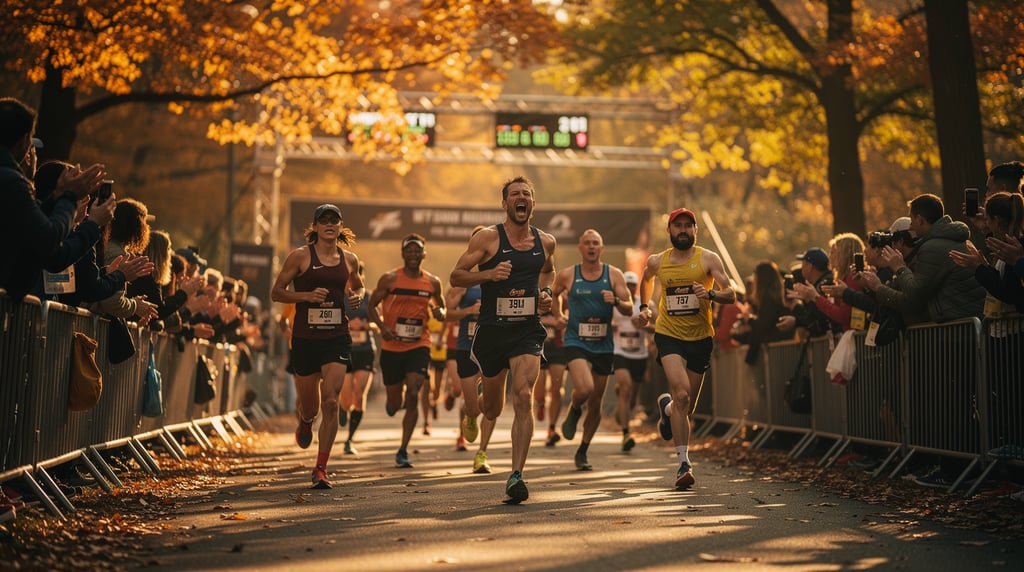
In only his third marathon, the 23-year-old Kenyan finishes closer to two hours than anyone in a record-eligible race. He died in a road accident four months later. His record still stands.

1940s marathon runner on a Boston road
1960s runner racing through Fukuoka
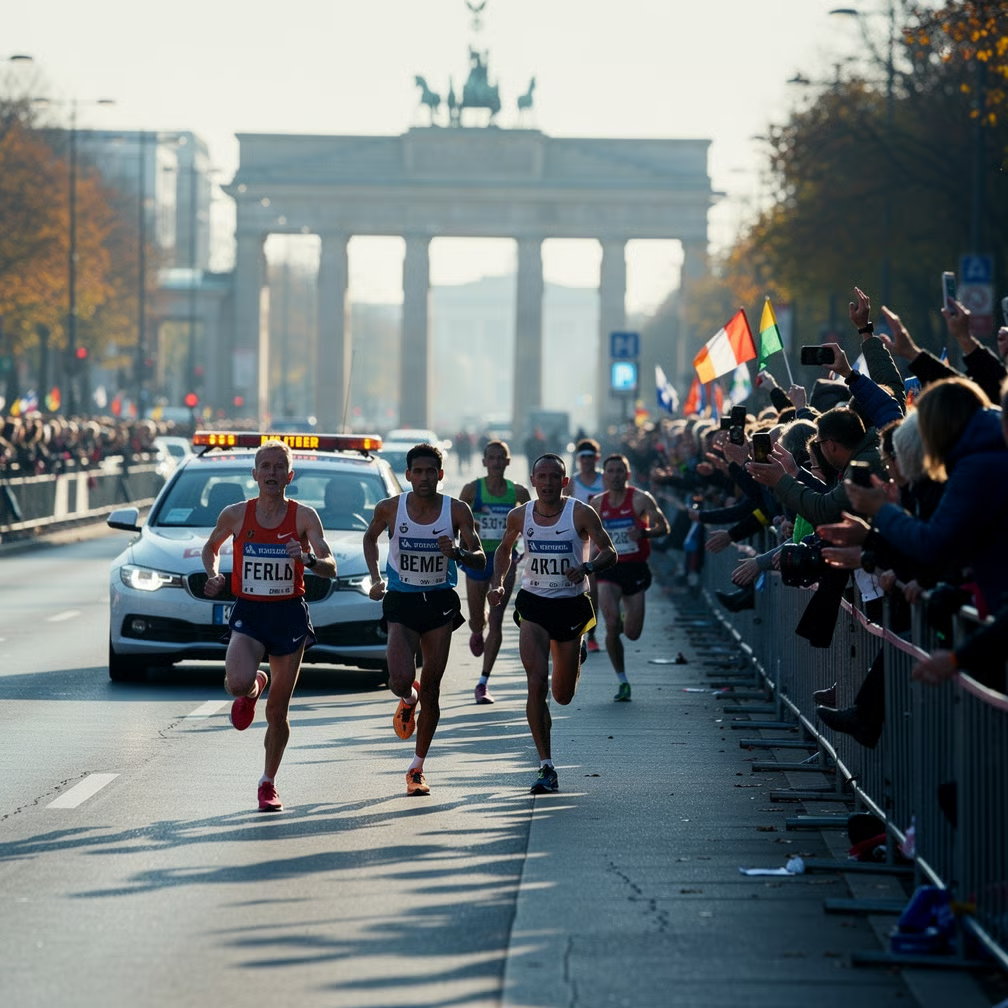
Elite marathon pack on a Berlin boulevard
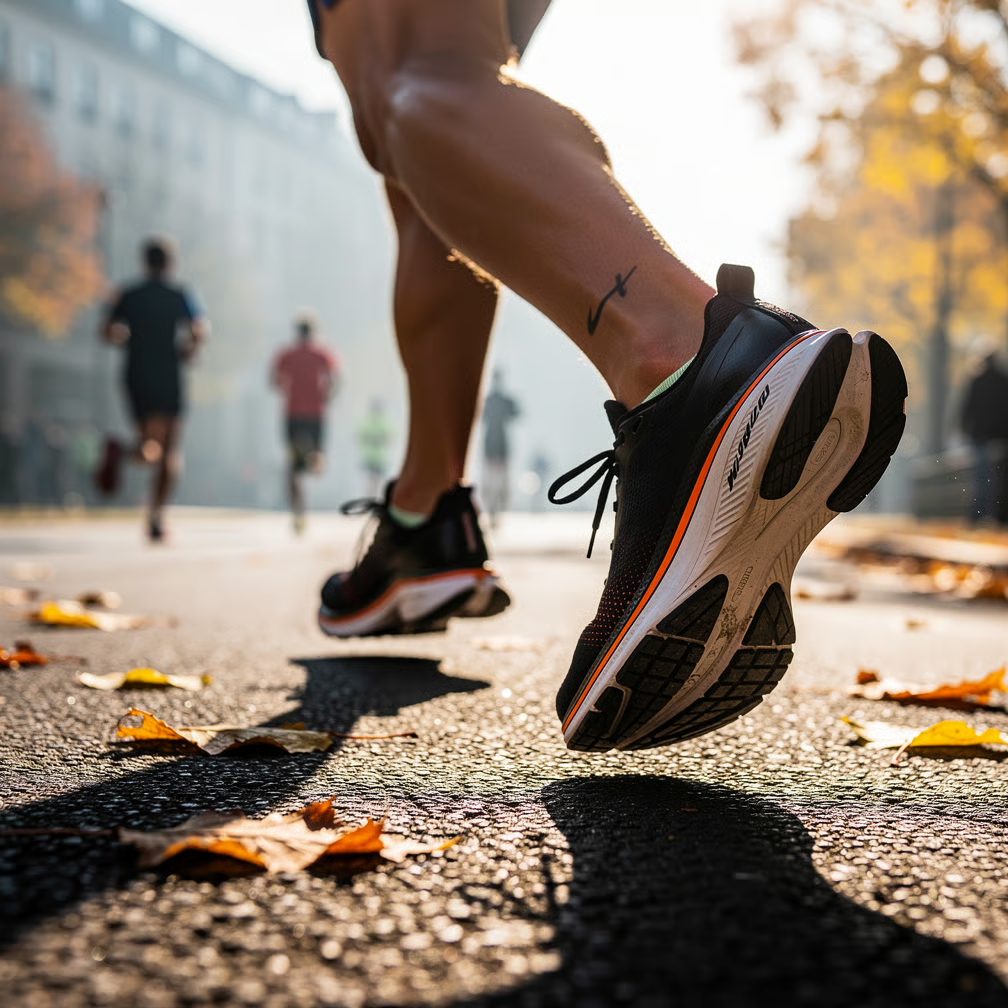
Carbon-plated racing shoes mid-stride
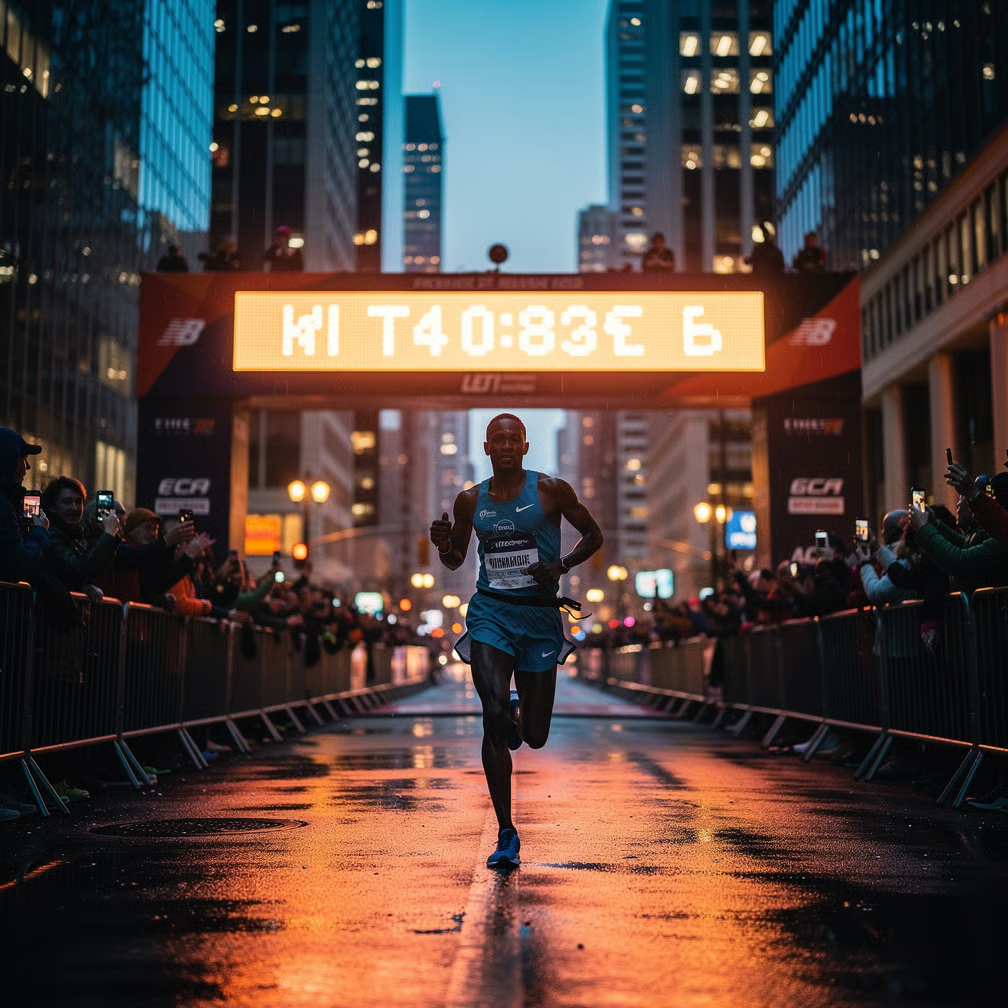
Runner approaching a Chicago finish line

Gap to two hours

+25:39

+9:36

+4:55

+1:39

+0:35

Photos are illustrative and do not show the athletes named. Times and details are compiled from World Athletics records: verify each one before publishing.

Training

Most marathon plans ask for 16 to 20 weeks and somewhere between 400 and 600 miles before race day. Very little of that is fast. The point is to teach the body to burn fat at an easy pace so it can save its limited carbohydrate for the end.

On race morning, all of that work gets tested by one decision repeated for hours: whether to hold the pace or push.

Mile 8 · 8:44 a.m.

Her watch reads 10:16 a mile. Sixteen weeks of slow Saturday long runs are the reason it feels this easy.

Words you will hear at the start line

Select a term to see what it means.

Negative split

Running the second half of a race faster than the first. Many of the fastest marathons ever run were paced this way, and the estimator later in this chapter builds its split plan around one.

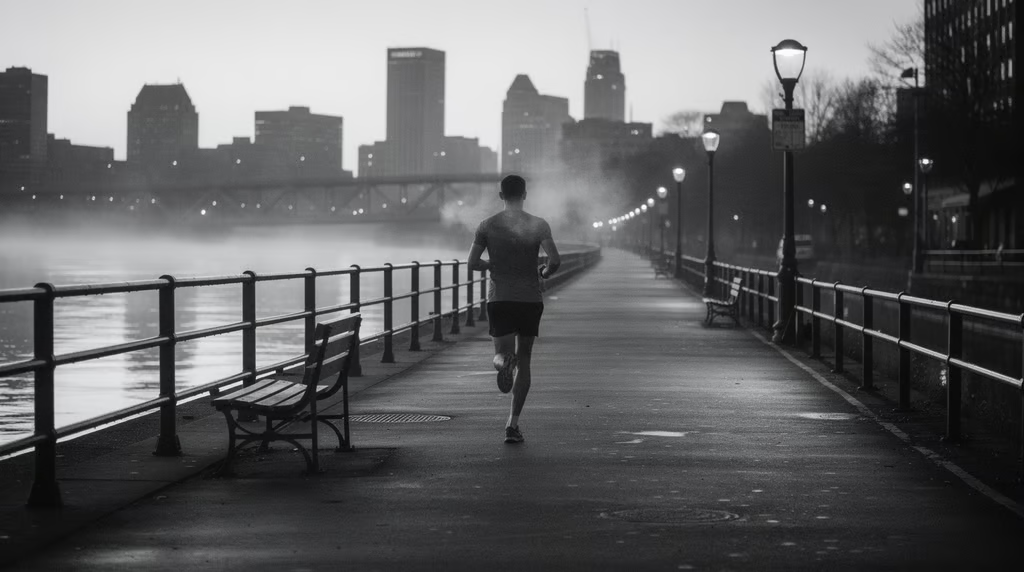
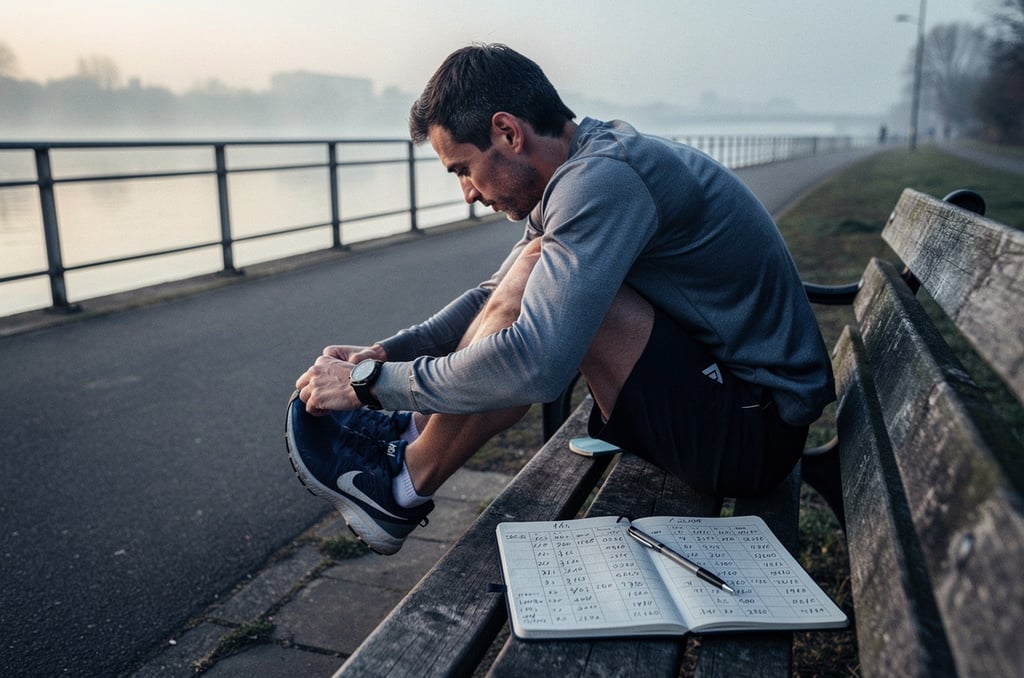
A lone runner training by a river before sunrise

Weeks before race day, Maya logs a long run by the river at first light. Most of the miles behind a finish like hers are run alone. [Photo credit]

Sixteen weeks in five moments

Those miles add up one week at a time. Select a moment on the line to follow Maya’s 16 weeks, from sign-up to start line.

The sign-up

She enters the lottery on a dare and gets in. Her longest run so far is six miles. The plan she downloads that night asks for four runs a week and one long run that grows every Saturday.

The runner and her training story are template placeholders. Replace them with your own reporting before publishing.

Try it yourself. Pick a recent race, set your time and tell us how much you run each week. The estimate updates as you go.

Estimate your marathon

Three inputs give you a finish time, a target pace and a split plan for race day.

50:00

3:56:55

9:02

per mile

5:37

per km

1:59:53

first half

1:57:02

second half

On this plan you would reach mile 20, where the wall usually waits, about 3:01:24 into your race.

A realistic target. Run the first half at this pace and keep something back for mile 20.

A simple estimate for this template. It scales your race time up to 26.2 miles with a standard endurance formula, then adds time for lower weekly mileage. Treat it as a starting point for training.

The split plan runs your second half slightly faster than your first. Coaches call that a negative split, and many of the fastest marathons ever run were paced that way. Most first-timers do the opposite.

The Runners ▸

The Runners

Fifty thousand people run the same 26.2 miles and have very different mornings. Three of them show how wide that range can be.

Mile 13.1 · 9:37 a.m.

Halfway in 2:14:55, running inside the 4:30 pace group. Dana Brooks’s sign bobs a few strides ahead.

Maya Ortiz signed up after a friend dared her at a birthday dinner. A school librarian who had never run farther than a 10K, she trained before work all summer and wrote her goal time on the back of her hand: 4:30. “I don’t need to be fast,” she said at the start. “I need to still be running at mile 22.”

Walter Hayes has started this race 22 times and finished it 21. The one he missed, he says, taught him more than the rest. At 61 he no longer chases a time. He runs with a small notebook and writes down one thing he notices at every mile.

Dana Brooks will not run her own race today. She is a pacer, carrying a sign marked 4:30 on a pole above the crowd, and roughly 300 people will try to stay within sight of it, Maya among them. Her job is to run every mile in the same time, no matter how she feels.

Runners, quotes and race details are placeholders for this template.

Fuel ▸

Why I run

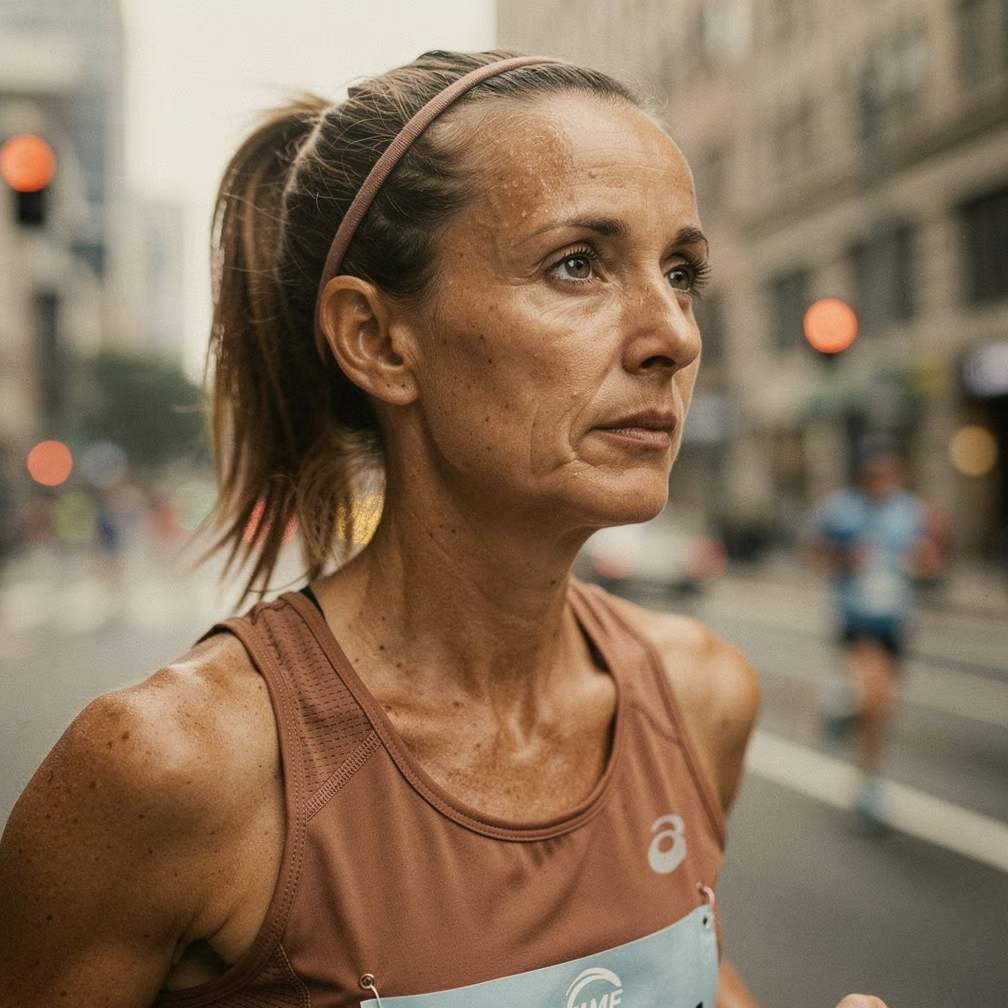
Portrait of a 45-year-old runner

“I started running the year my dad got sick. It was the only hour of the day when I wasn’t waiting for the phone to ring.”

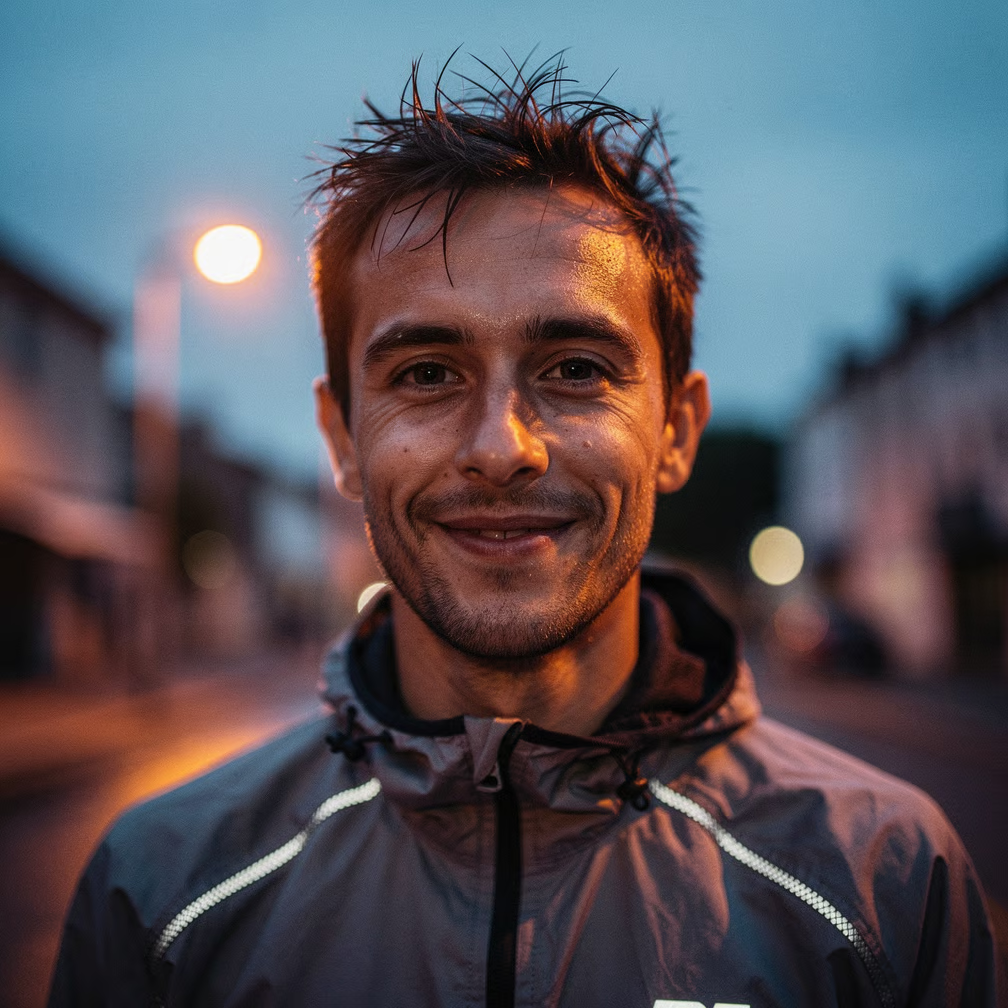
Portrait of a young running club member

“My running club meets at 5:30 a.m. in every kind of weather. Half of us came for fitness. All of us stayed for the people.”

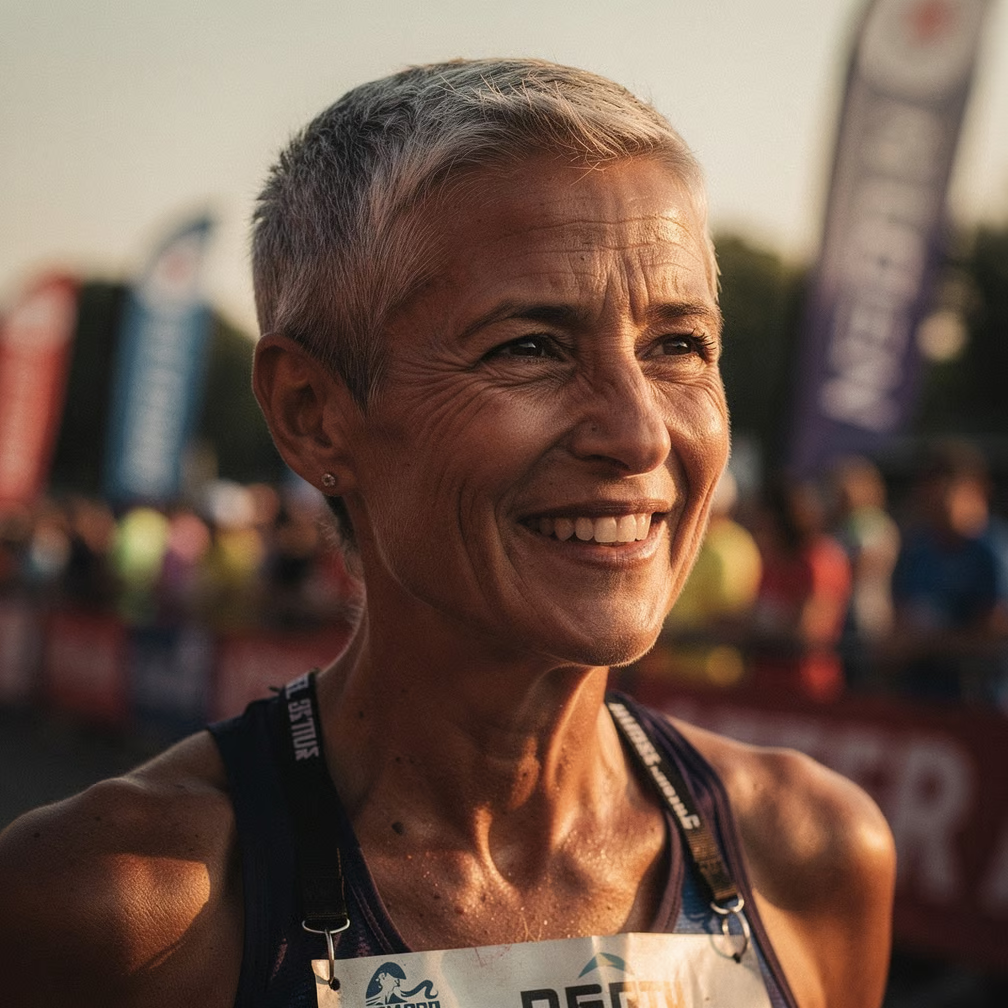
Portrait of a 68-year-old runner

“I’m not fast and I never will be. I just like knowing that on one morning a year I can go farther than I thought.”

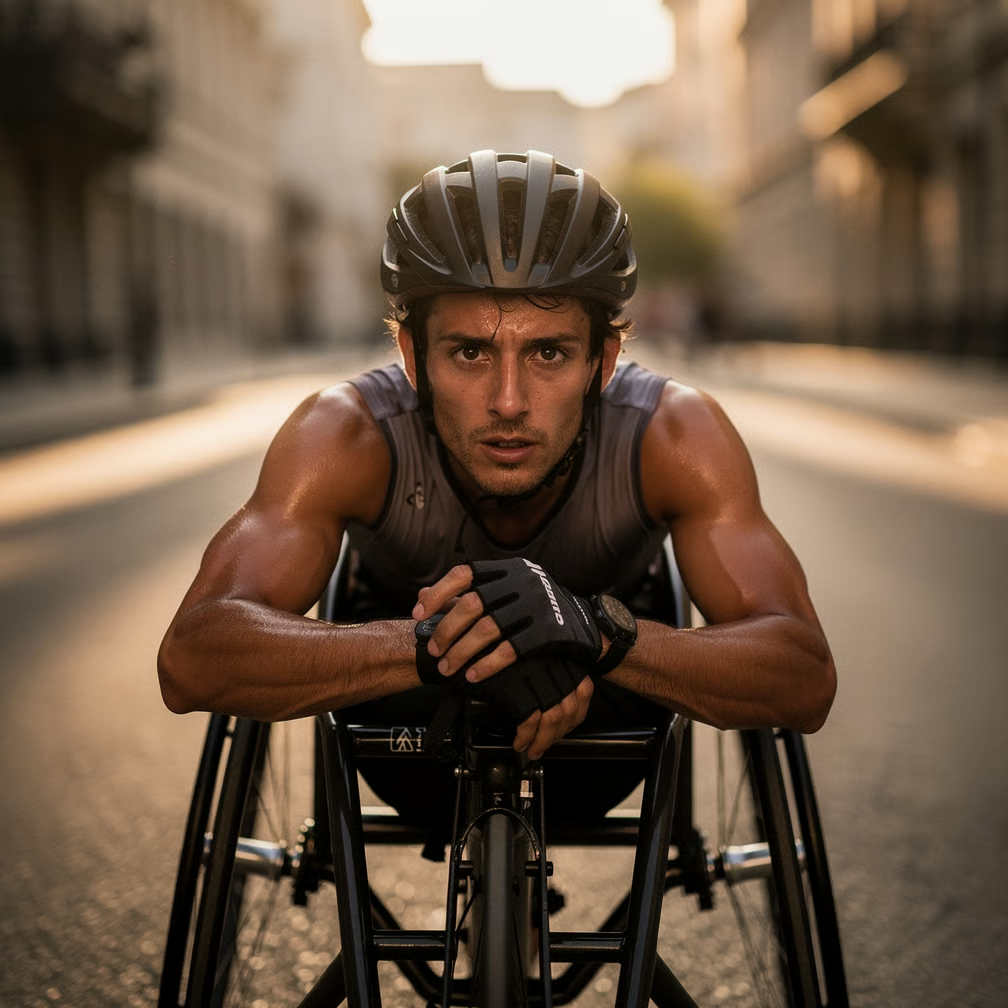
Portrait of a wheelchair racing athlete

“I run the course in a wheelchair. People see the uphill at mile 23 as the hard part. Try the downhill with no brakes.”

Runner names and quotes are placeholders for this template.

Fuel

The wall has a simple cause. Muscles run best on glycogen, a stored form of carbohydrate, and a trained runner can hold only about 2,000 calories of it. A marathon burns more than that.

When the stores run low, usually somewhere after mile 18, the body leans harder on fat, which releases energy more slowly. The pace drops whether the runner wants it to or not.

Mile 18 · 10:27 a.m.

Her fourth gel goes down hard. She has slipped a few seconds behind the pace group and has not noticed yet.

Energy in and energy out over 26.2 miles, in calories

Rough estimates. Actual figures vary with body weight, pace and training. Check with a sports nutrition source before publishing.

Glycogen stored in muscles and liver

~2,000

Taken in from gels and sports drinks

~600

Burned by a 150-pound runner

~2,600

Burned by a 200-pound runner

~3,500

That gap is why aid stations hand out gels and sports drink from the early miles, long before anyone feels hungry. Taking fuel late does not help much: the body cannot absorb it fast enough to catch up.

The runners who avoid the wall are rarely the strongest. They are the ones who ate on schedule.

A volunteer hands a cup of water to a passing runner

A volunteer holds out a cup of water at mile 14. A large city marathon goes through more than a million paper cups. [Photo credit]

The Crowd ▸

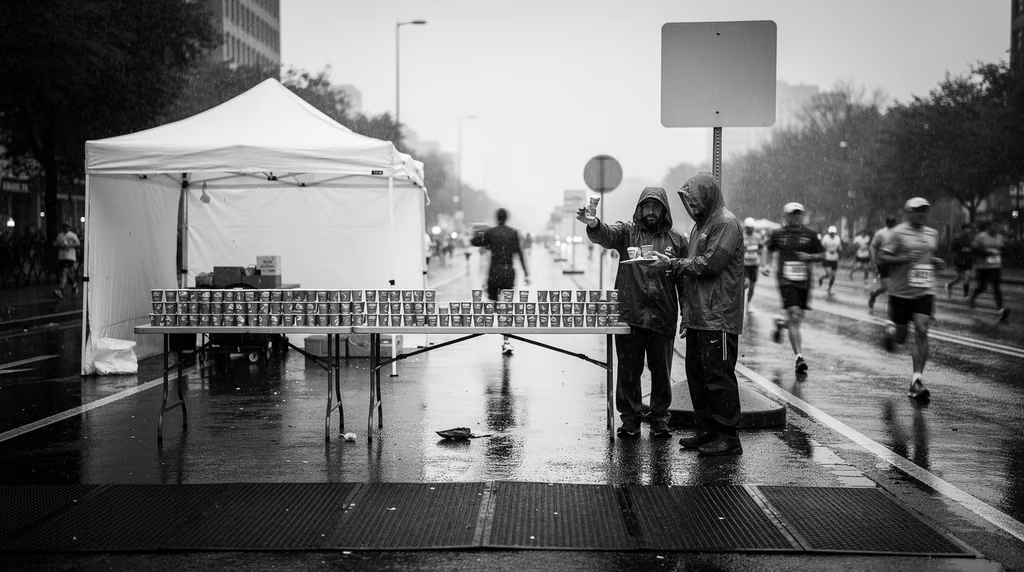
Inside an aid station

Maya will pass through 14 of these on the way to the finish, spending about 10 seconds at each. Tap the numbered pins to see what is waiting there.

A marathon aid station in the rain, with a table of water cups, volunteers, a white tent, a blank mile marker board and timing mats

Tap a numbered pin on the photo to see what happens at each stop.

Aid station layouts vary by race. Check the details with your event organizer before publishing.

Trouble after mile 20

Running out of fuel is the best known problem of the late miles, but it is not the only one. Flip each card to see what causes each problem and what runners do about it.

The wall

Cramps

Heat

Blisters

How well do you know the marathon?

Twenty miles down, six to go. Before the last 10K, three questions about the race and its history. Pick an answer to see how you did.

1. Why is a marathon 26.2 miles long?

The 1908 London Olympics. The course ran from Windsor Castle to the stadium and measured 26 miles 385 yards, and that distance became the official standard in 1921.

2. In what year were women first officially allowed to enter the Boston Marathon?

1972. Bobbi Gibb ran unregistered in 1966 and Kathrine Switzer ran with a bib in 1967, but women were not officially allowed until 1972. The first women’s Olympic marathon followed in 1984.

3. Roughly how many steps does it take to run a marathon?

Somewhere between 35,000 and 50,000, depending on height and stride. That is several days of a typical step count, packed into one morning.

Answer all three to see your score.

The Crowd

Ask finishers what got them through the last 10K and many will not mention training or fuel. They will mention a stranger at mile 21 who read the name off their bib and yelled it.

Mile 23 · 11:28 a.m.

Fifth Avenue climbs for a mile. A stranger reads the name off her bib and yells it, and Maya starts running again.

50,000

runners crossed the start line this morning, cheered by an estimated one million people along the course.

Illustrative figures. Replace with your race organizer’s official counts.

Some spectators come for one runner and stay for thousands. A few have stood at the same corner for decades, and they talk about the race the way other people talk about a holiday.

“You don’t cheer for the winners out here.

They’re long gone by the time we get loud.

You cheer for the ones who look like they want to stop,

and then they don’t.”

The Finish ▸

The Finish

At mile 23 the last climb is behind her. From there the course runs into Central Park, past the loudest crowds of the day, toward a clock she has been thinking about for 16 weeks.

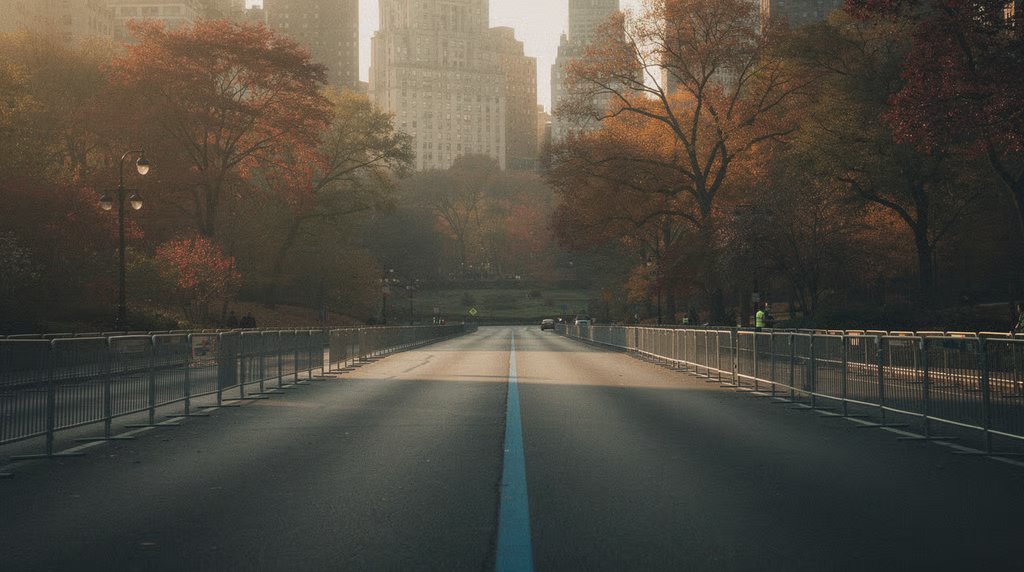
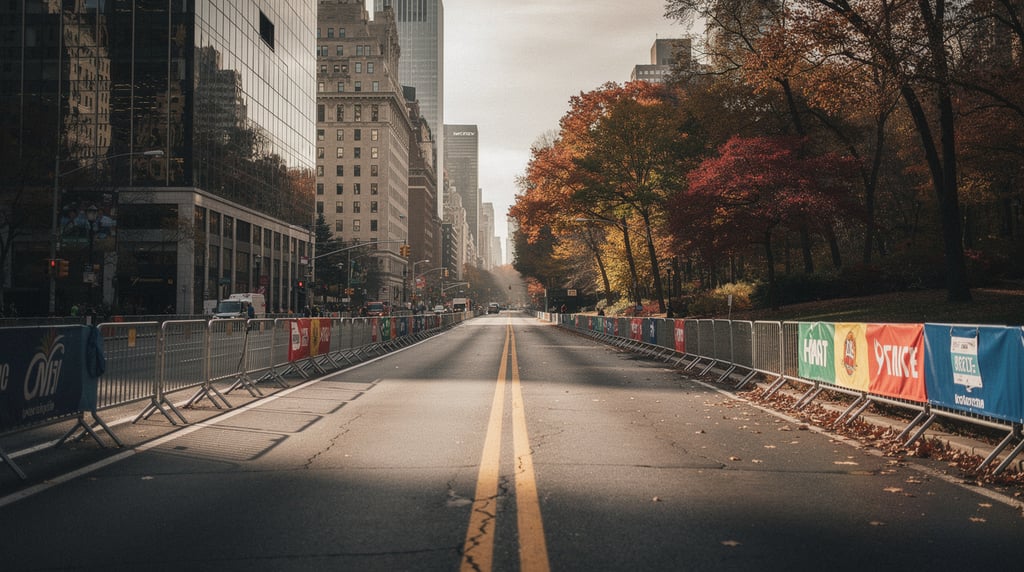
Empty Fifth Avenue marathon course
Empty Central Park South course
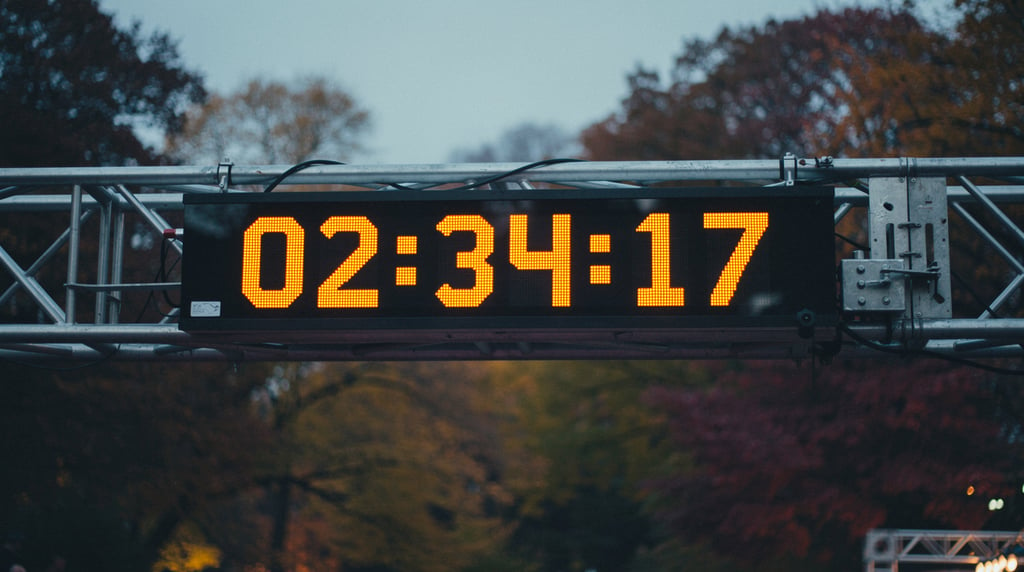
Marathon race clock close-up
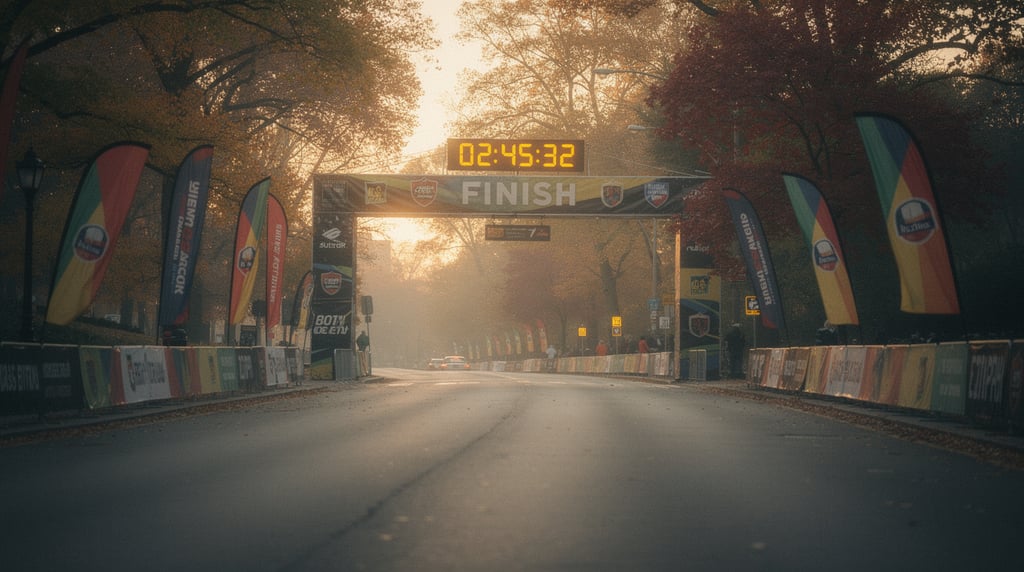
Road leading to the finish arch
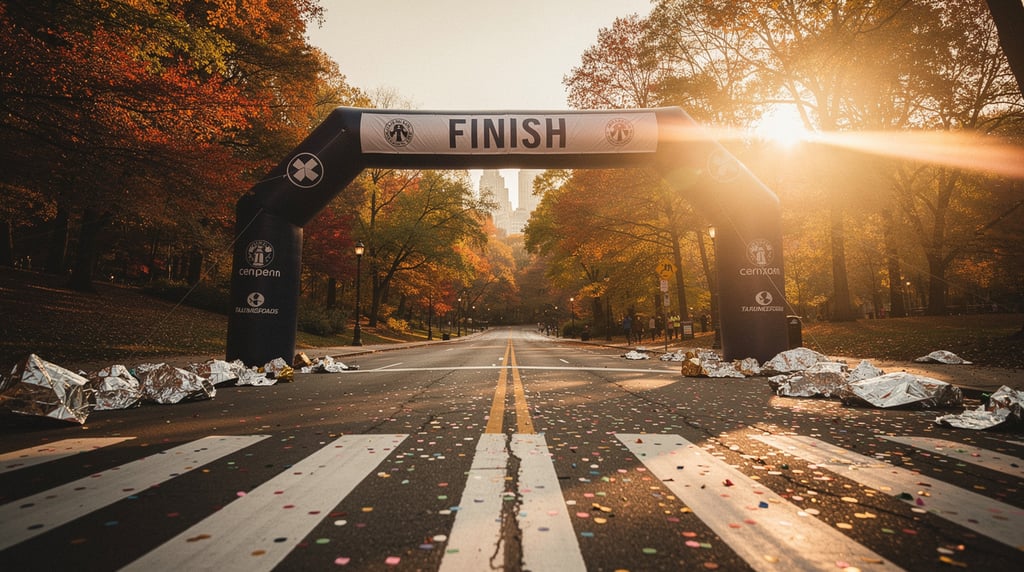
Empty marathon finish line

4:06:31

The last climb is behind her. It is downhill from here.

4:27:57

The crowds stand three deep along Central Park South. Her goal is 4:30.

4:30:00

The number on her hand goes by. She keeps running.

4:38:51

She can see the clock above the arch.

4:41:12

She crosses the line.

Maya Ortiz crossed the line at 4:41:12, eleven minutes slower than the number on her hand. Asked about the wall at mile 20, she laughed. “I met it,” she said. “Then I ran through it.”

Her race, mile by mile

How far each mile landed above or below her 10:18 goal pace. Hover over or tap a bar to see the split.

Slower than goal

Faster than goal

10:55

1

10:41

9:58

10:02

10:08

5

10:12

10:15

10:14

10:18

10:16

10

10:20

10:19

10:22

10:05

10:08

15

10:12

10:14

10:19

10:26

10:36

20

12:48

12:35

15:08

23

10:38

10:48

10:54

26

10:18 goal pace

18 of 20

of her first 20 miles landed within 20 seconds of goal pace.

9:37

lost to goal pace in miles 21 to 23, almost five minutes of it on the climb.

11:12

over the 4:30 written on her hand. She ran the last three miles close to her early pace.

Illustrative splits, built to match the times in this story. Replace them with the runner’s official chip splits before publishing.

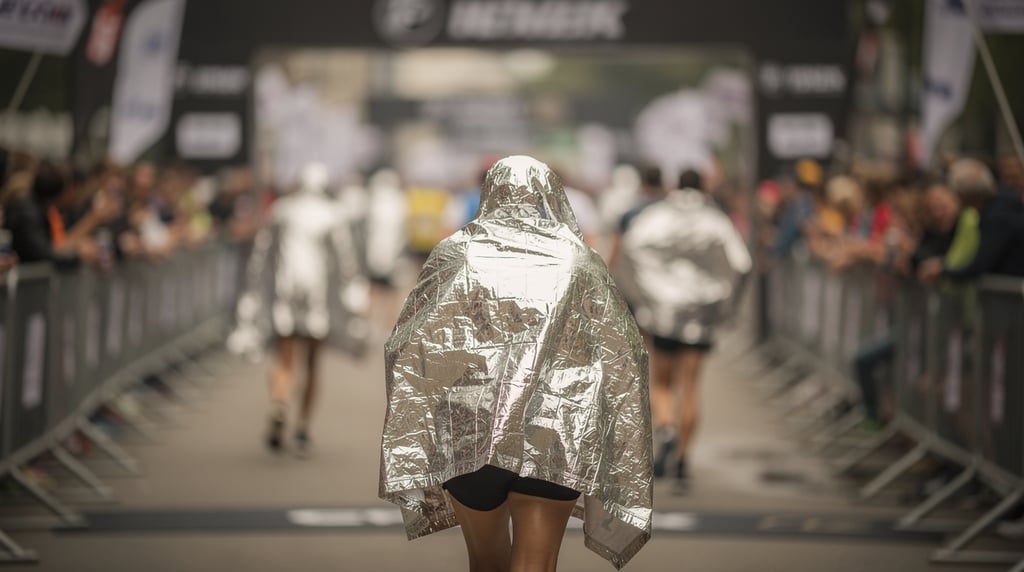
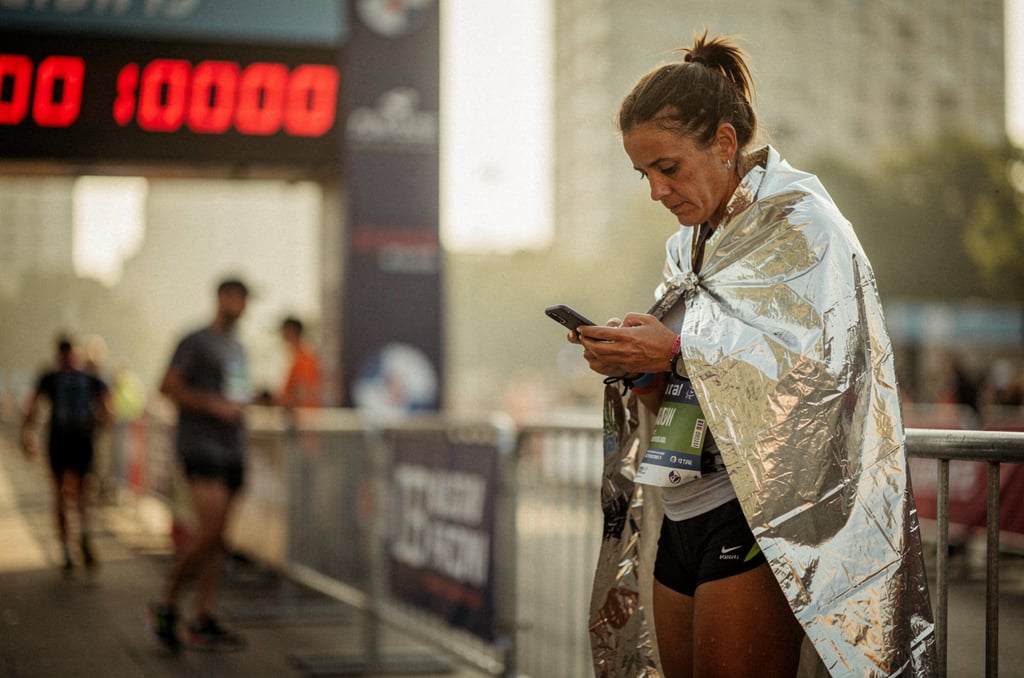
Runner in foil blanket seen from behind

Finishers wrap up in foil blankets in the chute beyond the line. Body temperature drops quickly once runners stop. [Photo credit]

Sources and methods

The runners

[Runner name] and the other runners in this story were interviewed in the weeks before the race and again at the finish. Their times come from official chip results.

The course

Distances, elevation and aid station locations come from [Race organizer]’s published course guide. Wave times and finisher counts were provided by the organizer.

Splits and charts

Mile splits are from [Timing provider]. World record times are from World Athletics progression lists. The pace estimator uses a standard endurance formula and is a guide, not a prediction.

Nutrition and medicine

Calorie and glycogen figures were reviewed by [Name], a sports dietitian at [Institution]. Descriptions of late-race problems were reviewed by the race’s medical director, [Name].

Spotted an error? Write to [corrections email]. This story was last updated [Month Day, Year].

More from race day

Finisher checking race results on a phone

Look up any finisher’s time and splits

Marathon start corrals at dawn

The morning in 40 pictures, from the start corral to the finish chute

Runner lacing shoes before a training run

Thinking about next year? A 16-week plan for your first marathon

How to make it your own

Start with the square brackets: the byline, publication name and photo credits. The people (Maya Ortiz, Walter Hayes, Dana Brooks and Gloria Reyes) are invented, so swap them for the runners you reported on. Then replace the illustrative splits, crowd counts and finish times with your race organizer’s official figures.

The world record history and the quiz answers are drawn from published records, but they were compiled from memory for this template. Check each one against World Athletics and race archives. Everything marked illustrative is invented.

Yes. Every block is built to be swapped: the timeline works for any sequence of events, the toggle for any before-and-after, the pinned scroll section for anything that unfolds over time, and the pace picker for any choice that adds up to a result.

No. The runners, the spectator and their quotes are written to show how the format works. Replace them with your own reporting before publishing.

They were generated with AI as stand-ins. Swap in credited photography before this story runs.

The Last 10K

Reporting by [Reporter Name]. Graphics by [Graphics Editor]. Edited by [Editor Name].

Photographs in this template are AI-generated placeholders. All runners, quotes and figures marked illustrative should be replaced with sourced reporting before publishing.